Part 2: London Typed 3 Words → Your Bread Jumped 15 %. The $10 Billion Forex Cartel

Table of Contents
ToggleThe Global Cartel That Rigged Your Groceries
2013 Johannesburg Checkers. Bread jumps 15 %, fuel spikes, your salary stays flat. 4 500 km away, a London trader types three words: “trade through 50”. That single chatroom line, part of a secret club called The Cartel, just moved the rand. Tonight we rewind to 2003, when six mega-banks invented the biggest financial conspiracy in history. We’ll walk inside their Bloomberg chats, watch Neil Phillips pocket $20 million on Boxing Day, and reveal how the same tricks hit South Africa for six straight years. This is Neon Strings 2025 – Part 2. The strings are glowing. Let’s cut the first one.
The Forex Cartel: Chatrooms, Fines & $10B Heist
Manipulation scandals have plagued FX markets since the late 90s. These involve trading collusion to rig benchmark rates, front-run client orders, or artificially influence exchange rates for profit. The most notorious (the largest financial collusion in history) is the 2013-2015 Forex Scandal, often called the “Forex Cartel,” which exposed systemic collusion at major banks. This led to over $10 billion in global fines, criminal convictions, and regulatory reforms. While the core events peaked in the mid-2010s, echoes persist in isolated cases into 2025, highlighting ongoing vulnerabilities in decentralized FX trading.
Key Events in the 2013-2015 Forex Scandal
- Revelation (June 2013): Bloomberg News exposed that traders at major banks( Barclays, UBS, JPMorgan, Citigroup, RBS, and HSBC) had colluded for over a decade via secret chatrooms (e.g., “The Cartel,” “The Mafia,” “One Team, One Dream”) to share client orders, fix prices around the 4 p.m. London WM/Reuters benchmark, and manipulate rates. Discussions included jokes about drugs, alcohol, and women alongside explicit rigging plans
Method:
- Investigations Launch: Regulators worldwide (U.S. DOJ, CFTC, FCA, FINMA, and others) probed the $4.7 trillion daily market. Evidence from chat transcripts showed traders coordinating to benefit proprietary desks or disadvantage clients.
- Arrests and Suspensions (2014-2017): Dozens of traders were fired or suspended, including high-profile figures like Rohan Ramchandani (Citigroup) and Richard Usher (JPMorgan/RBS). The first arrest was a former RBS trader in December 2014; in January 2017, three ex-traders (from Barclays, RBS, and JPMorgan) were indicted for antitrust conspiracy.
- Guilty Pleas and Convictions (2015): Five banks pleaded guilty to U.S. charges. Tom Hayes (ex-UBS) was sentenced to 14 years for Libor-related manipulation tied to FX (later reduced). As of 2025, several traders remain incarcerated.
Outcomes and Reforms
- Financial Impact: UK pension holders lost an estimated $11.5B annually due to distorted rates; global clients (corporations, investors) faced billions in hidden costs over a decade.
- Legal Repercussions: In addition to fines, banks faced class-action lawsuits (settled for ~$1.5B in the U.S.). UBS was temporarily barred from certain U.S. FX activities.
- Regulatory Changes: The FCA mandated IT overhauls to eliminate “dark data” silos. FINMA forced UBS to automate 95% of FX trading and separate conflicting roles. The 4 p.m. fix window was extended to five minutes in 2015 to reduce manipulation windows. The Bank for International Settlements pushed a global FX code of conduct.
The scandal proved: legal market-making can slide into illegal collusion — and no one noticed for 10 years.
Neil Phillips: One Trader, $20M Payout, Boxing Day Crash
The case of Neil Phillips, co-founder and former Chief Investment Officer (CIO) of Glen Point Capital LLC, represents one of the most high-profile individual convictions for FX market manipulation since the 2013-2015 Forex Cartel scandals. It highlights the vulnerabilities of emerging-market currencies like the South African rand (ZAR) during low-liquidity periods and the extraterritorial reach of U.S. regulators. Phillips, a South Africa-born trader, was accused of orchestrating trades to artificially breach a currency barrier, triggering a $20 million payout on a derivative bet. Below is a comprehensive breakdown, drawing on court documents, trial evidence, and post-conviction developments up to October 2025.
Background on Phillips and Glen Point Capital
Neil Phillips, 46 at the time of his 2023 conviction, is a veteran FX trader with experience at firms like Deutsche Bank and Millennium Management before co-founding Glen Point Capital in 2015. The London-based hedge fund, backed by billionaire George Soros’ family office, managed around $300 million in assets focused on global macro strategies, including emerging-market FX and commodities. Glen Point was registered as a commodity pool operator with the U.S. Commodity Futures Trading Commission (CFTC), subjecting it to U.S. oversight despite its UK base. Phillips held a CFTC registration as a trader, which later factored into jurisdictional arguments.
The case ties into broader FX manipulation concerns, echoing the USD/ZAR “Rand Rigging” scandal in South Africa, where banks were accused of colluding on the pair from 2007 to 2013. However, Phillips’ actions were individual and profit-driven, not cartel-like.
The Barrier Option Bet
In late October 2017, Glen Point purchased a “one-touch” digital barrier option on the USD/ZAR currency pair from Morgan Stanley, a U.S. investment bank acting as intermediary and prime broker. Key terms:
- Notional Value: $20 million.
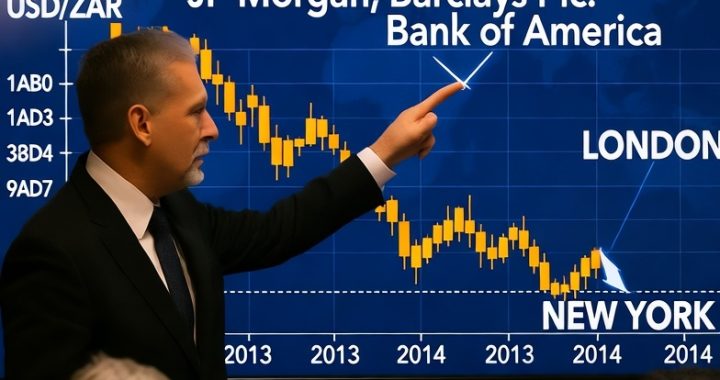
- Barrier Rate: 12.50 ZAR per USD (i.e., if USD/ZAR fell below 12.50 at any point, the option “touched” the barrier and paid out).
- Expiration: January 2, 2018.
- Payout Structure: Full $20 million if triggered; zero otherwise. Glen Point stood to receive $15.66 million, with a client fund getting $4.34 million.
This was a speculative bet on a strengthening ZAR (weakening USD/ZAR), amid optimism over Cyril Ramaphosa’s December 2017 election as South Africa’s president, which boosted rand sentiment. By late December, however, the rate hovered above 12.50, and the option risked expiring worthless.
The Manipulation Scheme: December 26, 2017
On Boxing Day (December 26, 2017)—a public holiday with thin FX trading volumes—Phillips allegedly executed the scheme from London. Around 11:45 p.m. London time on December 25 (early morning in Asia), he directed a Singapore-based Nomura trader (an executing broker) to sell approximately $725 million USD for ZAR over a 45-minute window until about 12:45 a.m. on December 26.
- Market Impact: The aggressive selling pushed USD/ZAR from ~12.52 to a low of 12.4990—just below the barrier—triggering the option. Once trading stopped, the rate quickly rebounded above 12.50, and it never dipped below again that day.
- Intent Evidence: Bloomberg Terminal chat logs were damning. Phillips messaged the Nomura trader: “trade through 50” (meaning through 12.50), “need it to trade through 50, 4990 is fine,” and “get it through.” A separate phone call referenced “f*cking around in dollar/rand tonight.” Trading halted immediately after the breach, supporting claims of artificial manipulation rather than genuine hedging.
- Post-Trigger Actions: Phillips instructed a Glen Point employee to notify Morgan Stanley of the trigger, omitting the manipulation. The payouts were wired from the U.S., netting Glen Point $15.66 million and the client $4.34 million.
- Prosecutors argued this was a “deceptive and manipulative scheme” under the Commodity Exchange Act (CEA), as the trades created an artificial price unrelated to supply/demand fundamentals.
Implications
- For South Africa and Emerging Markets: The case exposed USD/ZAR’s susceptibility to manipulation during holidays, amplifying volatility in an import-dependent economy. It fueled South Africa’s USD/ZAR rigging probe, with parallels in low-liquidity abuse. There was no direct economic quantification, but it contributed to the perception of rand weakness.
About The Author

Lungi Nkosi
Hi, I’m Lungi, the writer and researcher behind Political Nexus. I started this blog because I believe politics and history aren’t just distant, academic subjects — they shape how we live, how we understand the world, and how we imagine the future.
I’m not here to lecture; I’m here to ask questions, share insights, and spark conversations. Whether it’s unpacking a breaking news story, looking back at a key moment in history, or analyzing the choices of today’s leaders, I aim to keep things clear, thoughtful, and engaging.
My interest in politics and history comes from a lifelong curiosity about power — who holds it, how it’s used, and how ordinary people are affected by it. Over the years, I’ve seen how narratives are built, how facts are bent to fit agendas, and how history is used as both a weapon and a guide. That’s why Political Nexus is more than a blog — it’s a space for reflection, inquiry, and conversation.
I write about:
Politics: current events, government decisions, and global trends that affect South Africa and beyond.
History: how past events continue to echo in today’s politics and society.
Media & Narratives: questioning how stories are told, what gets left out, and why.
When I’m not writing, you can usually find me [behind the computer creating stories to tell, exploring books on history and philosophy, debating ideas over coffee with friends, or experimenting with new projects.
At the heart of it, I see myself as a storyteller — one who isn’t afraid to challenge easy answers, ask uncomfortable questions, and look deeper than the surface. My hope is that readers like you walk away from each article not just more informed, but more curious.
So, welcome to Political Nexus. Let’s explore, question, and learn together.
 From Soros to Sanctions: The 4 Levers That Rig Emerging Markets – BRICS’ 3 Fixes + 1 Fatal Flaw
 Part 2.1: The Rand Rigging Saga
 Part 1: Why Banks Manipulate Currencies
 Courts Have Ended Majority Rule in South Africa
 If State Power Built Afrikaner Prosperity, Why Isn’t It Working for Black South Africans?
 Rights Without Capacity: Is South Africa Building an Illusion of Delivery?
 Who Funds Court Rulings?