Part 1: Why Banks Manipulate Currencies

Imagine waking up in Johannesburg to find the rand has plummeted overnight, hiking the cost of your morning coffee and fuel—all triggered by trades executed thousands of miles away in London or New York. Currency manipulation, a shadowy force in global finance, spans a spectrum from legal central bank interventions stabilizing economies to illegal schemes rigging rates for profit. How do major financial institutions wield such power over emerging markets like South Africa without ever setting foot there? This first part explores the “why” behind these neon strings of power—why banks, from central to commercial, engage in activities that shape currencies. Is it economic necessity, profit-driven ambition, or something more? Join us to uncover the hidden motivations and mechanisms driving this remote influence on the Global South.
Monetary Policy (Central Banks)
Central banks like the Reserve Bank, Federal Reserve, European Central Bank, or Bank of Japan influence their national currencies to achieve macroeconomic goals, such as controlling inflation, stabilizing economic growth, or managing employment. These actions are typically part of monetary policy, not malicious manipulation. Legal tools include setting interest rates, eg, when the South African Reserve Bank raised interest rates to combat inflation. Quantitative Easing (QE): Central banks may buy back their own currency by purchasing government bonds paid for using newly created money, injecting money back into the economy, increasing the money supply, and potentially weakening the currency to boost exports or economic growth, eg, the Bank of Japan’s extensive QE programs have historically weakened the yen to support export-driven growth. Foreign Exchange Interventions: Central banks may directly buy or sell their currency in foreign exchange markets to stabilize or adjust their value.
These actions are generally legal, transparent, and aimed at economic stability.
Commercial Banks and Market Influence
The forex (FX) market is worth $7,5 trillion. Large commercial investment banks participate in this market. Their activities can influence currency prices, though not always with the intent to “manipulate” in a nefarious sense. Commercial banks trade for:
- Profit: Banks trade currencies to profit from exchange rate fluctuations, acting as market makers for clients (e.g., corporations needing to hedge international transactions). Their large-scale trades can move markets, especially in less liquid currencies. Example: A bank executing a massive client order to convert dollars to euros can temporarily strengthen the euro.
- Speculation: Some banks engage in proprietary trading, betting on currency movements based on economic data, geopolitical events, or market trends. This can amplify volatility, particularly in emerging market currencies.
- client services: Banks facilitate currency transactions for multinational corporations, governments, or hedge funds, which involve significant volumes and influence exchange rates.
Geopolitical and Economic Strategy
Some countries, through their central banks or state-owned institutions, influence currencies to gain trade advantages or counter external pressures. Weakening a currency to make exports cheaper is often called a “currency war.” For instance, Donald Trump has accused China of keeping the yuan undervalued to boost exports, though it maintains this is part of broader economic management. Countries facing sanctions or economic isolation may manipulate their currency to stabilize markets or counter external threats. For example, Russia’s central bank intervened heavily post-2022 sanctions to prop up the Ruble.
Market Dynamics and Perception
Currencies are influenced by supply and demand in the global FX market, where banks are major players. Large trades, whether by central or commercial banks, can shift exchange rates, even without intent to “manipulate.” However, the line between legitimate market activity and manipulation blurs when:
- Banks exploit insider information or collude, as seen in past scandals.
- High-frequency trading or algorithmic strategies amplify volatility, which some argue distorts “fair” market pricing.
Why It’s Controversial
- Impact on Trade: Currency movements affect global trade competitiveness. A weaker currency boosts exports but can raise import costs, affecting inflation and consumers.
- Global Imbalances: One country’s persistent intervention can lead to trade imbalances, sparking tensions (e.g., U.S.-China trade disputes).
- Ethical Concerns: Bank collusion or exploitation undermines trust in financial systems, as seen in the public backlash to FX scandals.
Banks manipulate currencies for stability, profit, or strategy—mostly legally, sometimes illicitly. This remote power shapes emerging economies, raising questions of fairness. In Part 2, we’ll explore scandals that exposed these neon strings, from global cartels to South Africa’s rand rigging. Stay curious!
About The Author

 From Soros to Sanctions: The 4 Levers That Rig Emerging Markets – BRICS’ 3 Fixes + 1 Fatal Flaw
 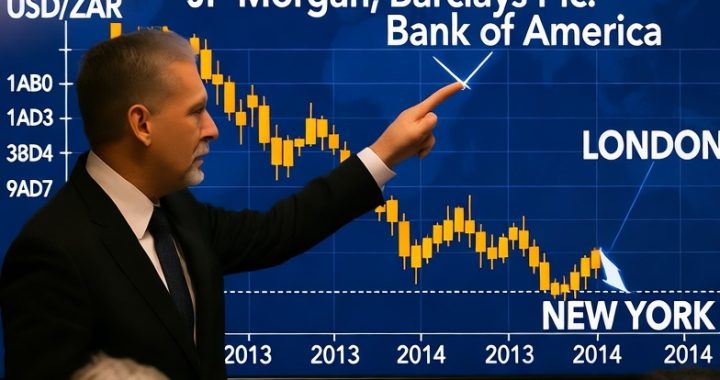 Part 2.1: The Rand Rigging Saga
  Part 2: London Typed 3 Words → Your Bread Jumped 15 %. The $10 Billion Forex Cartel
  Rights Without Capacity: Is South Africa Building an Illusion of Delivery?
  Who Funds Court Rulings?
  Media, Rulings & Policy Flow: How Courts Quietly Shape South African Governance
  Framing the Nation: How Media Narratives Shape Political Reality in South Africa