Media, Rulings & Policy Flow: How Courts Quietly Shape South African Governance
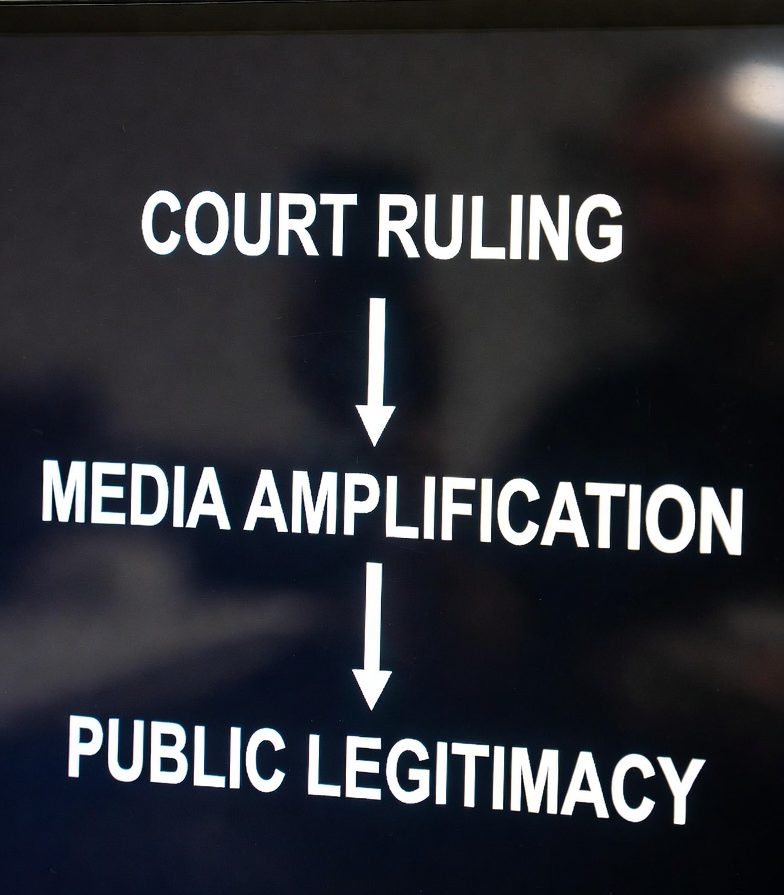
In constitutional democracies, policy is expected to flow from elected institutions: legislatures debate, executives implement, and voters hold both accountable.
But in South Africa, an alternative policy pipeline has increasingly emerged — one that begins not in Parliament, but in the courts.
This pipeline often follows a distinct sequence:
Litigation → Judicial ruling → Media framing → Public consensus → Legislative alignment
Over time, this process reshapes governance itself. Courts do not merely interpret law — they begin to influence policy direction. Media narratives then normalise these judicial outcomes, transforming legal rulings into political inevitabilities.
The result is what scholars term policy flow through adjudication.
Table of Contents
ToggleCourts as De Facto Policy Initiators
South Africa’s constitutional framework empowers courts to enforce socio-economic rights, particularly under:
- Section 26 – Right to housing
- Section 27 – Healthcare, food, water, social security
- Section 29 – Right to education
These provisions enable litigation when the state is perceived to have failed to deliver.
Landmark rulings such as:
- Government of the Republic of South Africa v Grootboom (2000) — housing obligations
- Minister of Health v Treatment Action Campaign (2002) — access to HIV treatment
did more than interpret rights — they compelled the executive to expand policy programs and reallocate resources.
The judiciary, in effect, became a policy accelerator.
The Basic Education Laws Amendment (BELA) Bill offers a fresh example of how court rulings, media framing, and legislative reform can converge.
Step 1: Litigation & Judicial Interpretation
South African courts have repeatedly affirmed that all children — regardless of immigration status — have the right to basic education.
This interpretation flows from Section 29(1)(a) of the Constitution, which guarantees the right to basic education without internal limitation.
Courts have ruled that denying undocumented learners access to schooling violates constitutional protections.
Step 2: Media Framing the Rulings
Following these rulings, media coverage increasingly adopted a rights-expansion framing:
Headlines and commentary emphasised:
- “Every child has a right to education”
- “Schools cannot exclude undocumented learners”
- “Documentation requirements violate constitutional rights”
This framing did two things:
- It normalised the rulings socially
- It positioned resistance as unconstitutional or discriminatory
Legal interpretation thus became moral consensus through repetition.
Step 3: Legislative Alignment — Enter the BELA Bill
The BELA Bill sought to codify and standardise several education governance issues, including:
- Admissions policies
- Language policy authority
- School governing body powers
Within public discourse, undocumented learner access became entangled in BELA debates — despite originating in court jurisprudence rather than parliamentary initiative.
Thus, the policy did not originate in legislative demand — it followed judicial precedent, amplified by media narrative.
This is policy flow in action
Media as Legitimisation Infrastructure
Media does not merely report rulings — it contextualises them.
Three framing patterns typically emerge:
- Rights Absolutism
Court decisions are framed as final moral truths rather than contestable legal interpretations.
- Institutional Delegitimisation
Opposition — often from school bodies, civil groups, or provincial authorities — is framed as obstructionist.
- Urgency Narratives
Media coverage emphasises crisis language:
- “Children denied schooling”
- “Rights under threat”
- “Urgent reform needed”
This framing compresses democratic deliberation timelines.
Additional Policy Flow Examples
Housing & Urban Policy
Post-Grootboom, informal settlement policy shifted toward emergency housing programs.
Municipal budgets were forced to expand housing allocations — not through an electoral mandate but through a judicial directive.
Public Health Policy
The Treatment Action Campaign ruling accelerated the national HIV/AIDS treatment rollout.
Budgetary and procurement frameworks were reshaped to comply with judicial orders.
Again, courts triggered policy movement where executive hesitation existed.
Prison Overcrowding & Detention Conditions
Litigation around inmate rights has forced the Department of Correctional Services to:
- Expand infrastructure
- Reform detention standards
- Adjust sentencing detention policies
Judicial rulings effectively dictated correctional policy priorities.
The Policy Triangle: Courts → Media → Legislature
Across these cases, a recurring triangle appears:
Stage | Institutional Actor | Function |
1 | Courts | Interpret rights expansively |
2 | Media | Legitimize rulings socially |
3 | Legislature | Codifies or funds outcomes |
By the time legislation responds, the normative battle is already settled.
Parliament is no longer initiating policy — it is formalising it.
The Democratic Paradox
This policy flow raises a structural question:
Where does democratic accountability sit in this pipeline?
Courts:
- Do not campaign
- Do not draft budgets
- Do not face voters
Yet their rulings can trigger:
- New spending obligations
- Administrative restructuring
- Legislative amendments
When courts expand rights, the fiscal and policy burden shifts to the elected branches.
But voters cannot sanction judges for these downstream consequences.
Media’s Role in Shielding the Process
Media framing often reinforces judicial legitimacy while muting democratic tension.
Rulings are presented as:
- Constitutionally inevitable
- Morally unquestionable
- Administratively urgent
This discourages scrutiny of trade-offs such as:
- Budget displacement
- Infrastructure strain
- Service delivery capacity
In the BELA context, for example, public debate focused heavily on access to rights — far less on school capacity, classroom ratios, or provincial funding readiness.
Governance by Convergence
What emerges is not judicial rule in isolation, but governance by institutional convergence:
- Courts interpret expansively
- Media normalises interpretations
- Legislatures operationalise them
Policy direction is thus shaped upstream of electoral politics.
This does not negate constitutionalism — but it complicates democratic authorship.
When Policy Flows Without Ballots
South Africa’s constitutional design intentionally empowers courts to safeguard rights.
But when judicial rulings begin to set policy tempo — and media framing converts rulings into political inevitabilities — governance starts to move along a parallel track to electoral democracy.
The BELA Bill debate illustrates this dynamic vividly:
A constitutional interpretation became media consensus, which then aligned with legislative action.
No campaign mandate.
No manifesto pledge.
No electoral referendum.
Yet policy shifted.
The democratic paradox is not that courts interpret law — it is that their interpretations can re-engineer governance outcomes without direct voter mediation.
As litigation increasingly becomes a policy gateway, South Africans must grapple with a foundational question:
If courts shape policy, and media legitimise it — where, ultimately, does democratic authorship reside?
About The Author

Lungi Nkosi
Hi, I’m Lungi, the writer and researcher behind Political Nexus. I started this blog because I believe politics and history aren’t just distant, academic subjects — they shape how we live, how we understand the world, and how we imagine the future.
I’m not here to lecture; I’m here to ask questions, share insights, and spark conversations. Whether it’s unpacking a breaking news story, looking back at a key moment in history, or analyzing the choices of today’s leaders, I aim to keep things clear, thoughtful, and engaging.
My interest in politics and history comes from a lifelong curiosity about power — who holds it, how it’s used, and how ordinary people are affected by it. Over the years, I’ve seen how narratives are built, how facts are bent to fit agendas, and how history is used as both a weapon and a guide. That’s why Political Nexus is more than a blog — it’s a space for reflection, inquiry, and conversation.
I write about:
Politics: current events, government decisions, and global trends that affect South Africa and beyond.
History: how past events continue to echo in today’s politics and society.
Media & Narratives: questioning how stories are told, what gets left out, and why.
When I’m not writing, you can usually find me [behind the computer creating stories to tell, exploring books on history and philosophy, debating ideas over coffee with friends, or experimenting with new projects.
At the heart of it, I see myself as a storyteller — one who isn’t afraid to challenge easy answers, ask uncomfortable questions, and look deeper than the surface. My hope is that readers like you walk away from each article not just more informed, but more curious.
So, welcome to Political Nexus. Let’s explore, question, and learn together.
 Rights Without Capacity: Is South Africa Building an Illusion of Delivery?
  Who Funds Court Rulings?
  Framing the Nation: How Media Narratives Shape Political Reality in South Africa
  Governing by Court Order: The Rise of Juristocracy in South Africa
  The Quiet Phasing Out of Childcare Institutions
  Zimbabwe’s Economy Improved. The Data Changed. The ZEP Just Kept Getting Extended
  Media, Rulings & Policy Flow: How Courts Quietly Shape South African Governance
If the media and the courts drive policy, does the role of voters become marginalized? Thanks for the perspective!