Zimbabwe’s Economy Improved. The Data Changed. The ZEP Just Kept Getting Extended
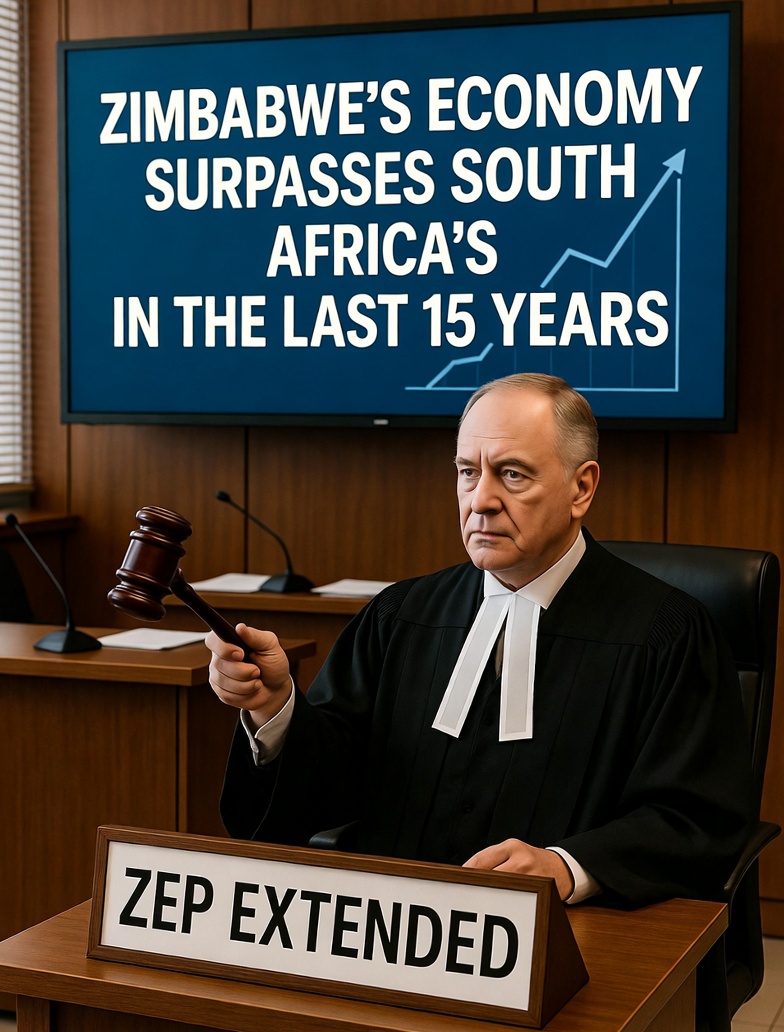
The Daily Investor has revealed that the Zimbabwean economy has tripled in size and has outperformed the South African economy over the past 15 years. This development marks a significant shift for a country long associated with economic collapse, hyperinflation, and prolonged stagnation. While Zimbabwe continues to face serious structural challenges, its economic trajectory over the last decade and a half reflects material change rather than permanent crisis.
During this same period, South Africa assumed what it framed as a humanitarian responsibility by accommodating large numbers of Zimbabwean nationals, both legally and illegally. In 2010, the South African government granted hundreds of thousands of undocumented Zimbabweans a special exemption permit allowing them to live and work in the country. The Zimbabwe Exemption Permit (ZEP) was explicitly presented as a temporary measure, justified by extraordinary economic conditions in Zimbabwe at the time.
However, what was intended as short-term humanitarian relief has now been extended repeatedly for more than a decade. Most notably, on 28 June 2023, a judge ruled that economic conditions in Zimbabwe had not changed and that the ZEP should therefore be extended once again. This ruling has become a central pillar supporting the continued existence of the permit.
That conclusion now sits uneasily alongside available economic data. While Zimbabwe’s growth has been uneven and remains accompanied by currency instability, governance concerns, and high unemployment, an economy that has tripled in size over a 15-year period cannot reasonably be described as unchanged. Growth does not imply prosperity, nor does it mean that all citizens are economically secure. But growth does indicate transformation. An economy that has shifted in scale, structure, and output no longer meets the definition of a static crisis economy.
The legal justification for repeated ZEP extensions was never based on whether Zimbabwe had become wealthy or fully stable. It was based on whether exceptional and temporary conditions necessitating special protection still existed. When courts assert that conditions have “not changed” without engaging with evidence that clearly suggests otherwise, the issue moves beyond policy disagreement and into the realm of evidentiary failure.
This raises a fundamental question: on what basis are such judicial determinations being made? If economic claims are central to the justification for extraordinary legal exemptions, then those claims must be tested against current, measurable indicators. Relying on outdated assumptions or broad generalisations undermines the integrity of the ruling itself.
South Africa’s own economic trajectory further complicates the logic underpinning ZEP extensions. Over the same period in which Zimbabwe’s economy expanded, South Africa experienced prolonged stagnation, declining per-capita income, worsening unemployment, and increasing fiscal pressure. In real terms, the South African economy has struggled to generate sufficient growth to absorb its own labour force, let alone sustain indefinite inflows under a humanitarian framework.
If relative economic hardship is sufficient grounds for indefinite exemption from immigration law, then the justification becomes incoherent. Economic difficulty is not unique to Zimbabwe, nor is it static. A country facing structural decline cannot indefinitely rely on humanitarian arguments without reassessing its own capacity and priorities. What begins as compassion risks becoming policy paralysis.
More troubling still is the standard of judicial scrutiny applied in reaching such rulings. Courts derive their legitimacy not from moral authority alone, but from rigorous engagement with facts. Declaring that an economy has “not changed” without clearly identifying which indicators were considered, how contrary evidence was weighed, or why certain data was dismissed stretches the meaning of legal reasoning. Judicial independence does not imply insulation from empirical reality.
There is a critical distinction between judicial discretion and judicial carelessness. Courts are not expected to function as economic think tanks, but they are expected to interrogate the claims placed before them. When unsupported or inaccurate assertions are elevated to legal fact, the authority of the judiciary does not strengthen the ruling — it weakens public confidence in the institution itself. Legal decisions grounded in fiction, even well-intentioned fiction, undermine the rule of law.
The continued extension of ZEP increasingly appears to be driven not by updated analysis, but by institutional inertia. Temporary protection has quietly evolved into a de facto permanent migration policy, without parliamentary debate, legislative reform, or transparent criteria. This is not how democratic policy should be made.
If Zimbabwe’s economic conditions have demonstrably changed, even if imperfectly, then the legal basis for repeated ZEP extensions must also change. At minimum, extensions should be subject to transparent, periodic review based on clearly defined benchmarks: economic absorption capacity, labour market conditions, and demonstrable risk to returnees. Without such scrutiny, ZEP ceases to be a humanitarian instrument and becomes an unexamined exception to immigration law.
If South Africa has effectively decided that ZEP holders should remain permanently, then that decision should be made openly through legislation, not indirectly through judicial rulings built on claims that no longer align with the data. A constitutional democracy cannot sustain policy on legal fiction. When facts evolve, the law must confront them — not ignore them.
Read Next ZEP Extension: Compassion or Complacency
Table of Contents
ToggleAbout The Author

Lungi Nkosi
Hi, I’m Lungi, the writer and researcher behind Political Nexus. I started this blog because I believe politics and history aren’t just distant, academic subjects — they shape how we live, how we understand the world, and how we imagine the future.
I’m not here to lecture; I’m here to ask questions, share insights, and spark conversations. Whether it’s unpacking a breaking news story, looking back at a key moment in history, or analyzing the choices of today’s leaders, I aim to keep things clear, thoughtful, and engaging.
My interest in politics and history comes from a lifelong curiosity about power — who holds it, how it’s used, and how ordinary people are affected by it. Over the years, I’ve seen how narratives are built, how facts are bent to fit agendas, and how history is used as both a weapon and a guide. That’s why Political Nexus is more than a blog — it’s a space for reflection, inquiry, and conversation.
I write about:
Politics: current events, government decisions, and global trends that affect South Africa and beyond.
History: how past events continue to echo in today’s politics and society.
Media & Narratives: questioning how stories are told, what gets left out, and why.
When I’m not writing, you can usually find me [behind the computer creating stories to tell, exploring books on history and philosophy, debating ideas over coffee with friends, or experimenting with new projects.
At the heart of it, I see myself as a storyteller — one who isn’t afraid to challenge easy answers, ask uncomfortable questions, and look deeper than the surface. My hope is that readers like you walk away from each article not just more informed, but more curious.
So, welcome to Political Nexus. Let’s explore, question, and learn together.
 Rights Without Capacity: Is South Africa Building an Illusion of Delivery?
  Who Funds Court Rulings?
  Media, Rulings & Policy Flow: How Courts Quietly Shape South African Governance
  Framing the Nation: How Media Narratives Shape Political Reality in South Africa
  Governing by Court Order: The Rise of Juristocracy in South Africa
  The Quiet Phasing Out of Childcare Institutions
1 thought on “Zimbabwe’s Economy Improved. The Data Changed. The ZEP Just Kept Getting Extended”