The Quiet Phasing Out of Childcare Institutions
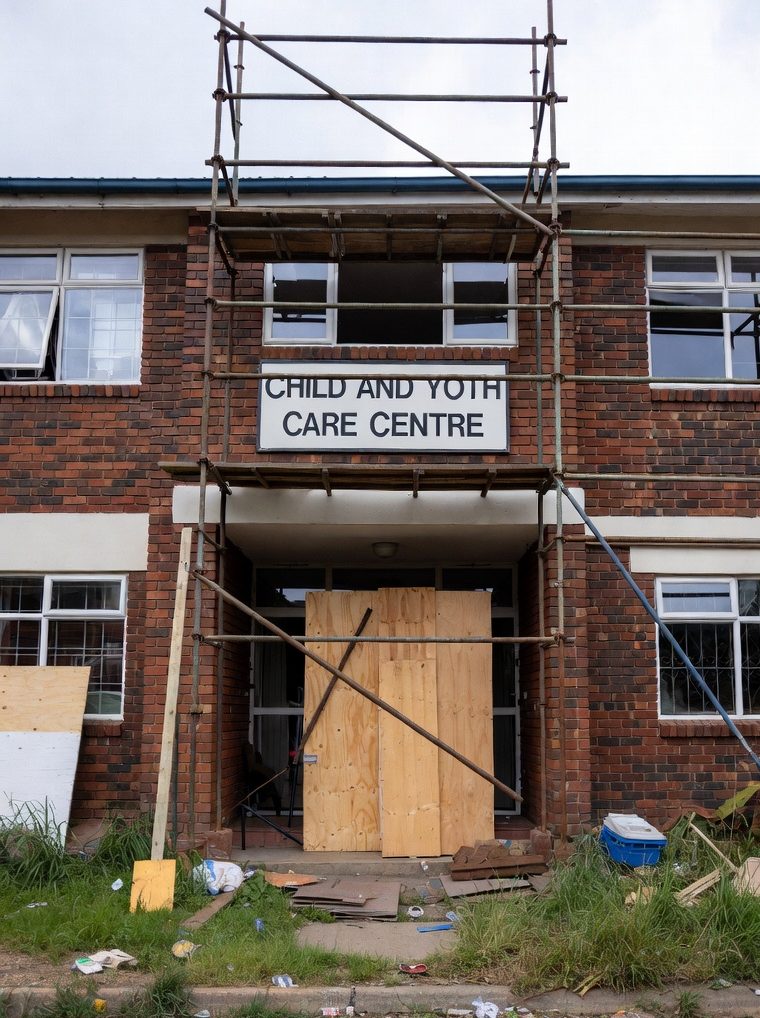
The ANC — and now possibly the Government of National Unity (GNU) — has agreed to a major structural shift in South Africa’s childcare system: the gradual phasing out of child and youth care homes.
According to the Department of Social Development, this forms part of a long-term policy agenda running toward 2030. The plan is to close state-run institutional homes and transition vulnerable children into what is termed “family-based care” — primarily reunification with relatives and placement within the foster care system.
On paper, the policy sounds humane. Progressive, even.
It aligns with global child-protection frameworks that argue children develop better in family environments than in institutional settings. The language is steeped in rights-based care, community integration, and restorative family structures.
But South Africans have heard this language before — and history demands that we interrogate it more carefully than policy brochures invite us to.
Table of Contents
ToggleThe Shadow of Life Esidimeni
We were told similar things during South Africa’s mental health deinstitutionalisation process.
Psychiatric patients were moved out of state facilities and placed into NGOs and community care settings under the promise of more humane, cost-effective care. What followed was the Life Esidimeni tragedy — a preventable disaster in which over 140 vulnerable mental health patients died after being transferred to unprepared and under-resourced facilities.
That episode exposed what can happen when the state withdraws faster than alternative systems can safely absorb responsibility.
Now, deinstitutionalisation is no longer confined to psychiatric institutions. It is extending into childcare.
Once again, the state appears to be shifting the burden of care away from government facilities and onto families, NGOs, and communities — many of whom are already financially strained, socially overburdened, and structurally under-supported.
Which raises a constitutional and moral question:
What is the government’s duty — and how does it intend to fulfil its end of the social contract?
Because this childcare reform does not exist in isolation. It forms part of a broader, decades-long pattern in South Africa’s governance model — one that increasingly blurs the line between reform and retreat.
Policing: The Rise of Private Security
Consider policing.
South Africa now has one of the largest private security industries in the world. In many suburbs, business districts, and even townships, private security companies — funded directly by residents and businesses — perform patrols, rapid response, and crime deterrence functions that citizens would ordinarily expect from SAPS.
In practice, policing has become a hybrid system where those who can afford private protection supplement — or replace — state security.
Healthcare: A Two-Tier System
Healthcare tells a similar story.
Public hospitals remain critically overstretched, understaffed, and infrastructure-strained. Those with financial means migrate into private healthcare through medical schemes, while the majority rely on an overburdened public system.
The result is not universal care — but parallel care, divided by income.
Education: Parallel Schooling Realities
Education follows the same trajectory.
Public schools continue to struggle with overcrowding, infrastructure backlogs, and uneven outcomes, while private and independent schools expand — effectively becoming parallel systems of quality education for those who can pay.
Access to quality education is increasingly mediated not by citizenship, but by affordability.
Basic Services: The Household Takeover
Even basic services are no longer uniformly state-provided.
Middle-class households increasingly generate their own electricity through solar installations due to grid instability. Drinking water is purchased where municipal supply is unreliable. Private boreholes, water tankers, and filtration systems are becoming normalized substitutes for public provision.
In some municipalities, residents even privately fund road repairs, waste removal, and security patrols where local government has failed.
The pattern is unmistakable.
Service after service is drifting away from direct state delivery toward private provision, NGO management, or household self-funding.
Childcare now appears to be joining that list.
Capacity vs. Principle
The official framing is that institutional homes are outdated and that children fare better in family environments. That may be true in principle.
But principle cannot substitute for capacity.
Do we have enough vetted, trained, and monitored foster families to absorb thousands of vulnerable children?
Do we have sufficient social workers to supervise placements, conduct safety checks, and intervene when reunification fails?
Are extended families — many already living below the poverty line — financially equipped to take in additional children without deepened hardship?
And crucially: when placements break down, where do these children go if institutional homes no longer exist?
Without credible answers, deinstitutionalisation risks becoming less about child welfare and more about cost transfer — moving fiscal and operational responsibility from the state onto society.
The Social Contract Under Strain
his brings us back to the social contract.
Citizens pay taxes not merely as a legal obligation, but as part of an exchange: the state collects revenue in order to provide public goods — safety, education, healthcare, infrastructure, and protection for the vulnerable.
But what happens when the state continues to collect at high compliance levels while steadily withdrawing from direct provision?
South Africa’s tax-to-GDP ratio is comparable to many upper-middle-income countries. Compliance enforcement remains strict. Fiscal obligations remain non-negotiable.
Yet citizens are increasingly required to self-provide core services.
They pay for private security because public policing is insufficient.
They pay for private schooling because public education is uneven.
They pay for private healthcare because public facilities are overwhelmed.
They pay for solar power because electricity supply is unstable.
They pay for water because municipal systems falter.
And now, through foster care absorption and family placements, communities may be expected to shoulder greater responsibility for vulnerable children as well.
From Provider to Regulator?
At what point does this cease to be a mixed delivery model and become systemic state withdrawal?
If safety, education, healthcare, energy, water — and now childcare — are increasingly privatized, outsourced, or community-absorbed, then a difficult but necessary question emerges:
What exactly is the government still responsible for delivering directly?
Is the modern South African state evolving into a provider of services — or merely a regulator of services delivered by others?
Because there is a profound difference between governing and outsourcing governance.
One builds state capacity. The other manages its absence.
Reform — or Retreat?
None of this is to argue that family-based childcare is inherently flawed. In many cases, children do thrive in stable family environments.
But successful transitions require deep infrastructure: funding, monitoring, social worker expansion, foster training, and enforceable oversight.
Without that, deinstitutionalisation risks repeating the mistakes of the past — not in psychiatric wards this time, but in the lives of vulnerable children.
So the question is not whether reform is necessary.
The question is whether reform is being pursued with capacity — or as a substitute for it.
Because when the state steps back from care, someone else must step forward.
And when that “someone else” is already struggling, the cost of policy failure is not theoretical.
It is human.
And it is borne, as always, by those with the least ability to absorb it.
About The Author

Lungi Nkosi
Hi, I’m Lungi, the writer and researcher behind Political Nexus. I started this blog because I believe politics and history aren’t just distant, academic subjects — they shape how we live, how we understand the world, and how we imagine the future.
I’m not here to lecture; I’m here to ask questions, share insights, and spark conversations. Whether it’s unpacking a breaking news story, looking back at a key moment in history, or analyzing the choices of today’s leaders, I aim to keep things clear, thoughtful, and engaging.
My interest in politics and history comes from a lifelong curiosity about power — who holds it, how it’s used, and how ordinary people are affected by it. Over the years, I’ve seen how narratives are built, how facts are bent to fit agendas, and how history is used as both a weapon and a guide. That’s why Political Nexus is more than a blog — it’s a space for reflection, inquiry, and conversation.
I write about:
Politics: current events, government decisions, and global trends that affect South Africa and beyond.
History: how past events continue to echo in today’s politics and society.
Media & Narratives: questioning how stories are told, what gets left out, and why.
When I’m not writing, you can usually find me [behind the computer creating stories to tell, exploring books on history and philosophy, debating ideas over coffee with friends, or experimenting with new projects.
At the heart of it, I see myself as a storyteller — one who isn’t afraid to challenge easy answers, ask uncomfortable questions, and look deeper than the surface. My hope is that readers like you walk away from each article not just more informed, but more curious.
So, welcome to Political Nexus. Let’s explore, question, and learn together.
 Rights Without Capacity: Is South Africa Building an Illusion of Delivery?
  Who Funds Court Rulings?
  Media, Rulings & Policy Flow: How Courts Quietly Shape South African Governance
  Framing the Nation: How Media Narratives Shape Political Reality in South Africa
  Governing by Court Order: The Rise of Juristocracy in South Africa
  Zimbabwe’s Economy Improved. The Data Changed. The ZEP Just Kept Getting Extended