Did South Africans Really Elect Their Government?
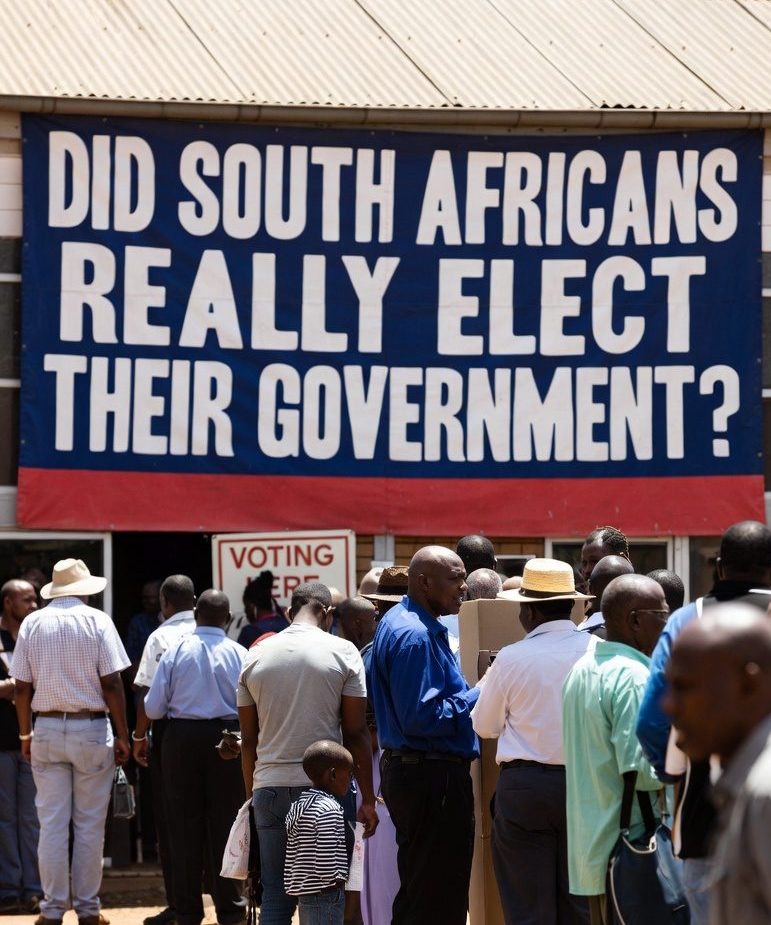
South Africa currently has a coalition government known as the Government of National Unity (GNU). Yet a critical question remains largely unexamined: did South Africans elect their government, or merely the parties that later negotiated power among themselves?
In the absence of an outright electoral majority, no single party was eligible to govern alone. While citizens voted for political parties, they did not vote for the coalition arrangements, executive composition, or governing agreements that emerged after the election. Those decisions were made through post-election negotiations between political elites. This raises a fundamental question: how much power do voters truly have in South Africa’s democracy?
Democracy is commonly defined as “rule by the people,” derived from the ancient Greek demos (people) and Kratos (rule). But under South Africa’s current political system, can it honestly be said that the people rule?
The earliest known democracy emerged in ancient Athens, where adult male citizens were required to participate directly in governance. Citizens served in public office by lot, proposed and voted on laws themselves, and could be penalised for failing to participate. Political power was not delegated—it was exercised.
This system, known as direct democracy, contrasts sharply with South Africa’s representative democracy, where citizens elect representatives who govern on their behalf. In theory, these representatives are accountable to voters. In practice, however, this system has increasingly distanced political power from the electorate.
Representative democracy has not merely delegated authority—it has concentrated it, creating conditions in which political leaders are more accountable to party structures, donors, and elite networks than to ordinary citizens.
South Africa’s democracy becomes even more questionable when political funding is examined. Public funding of political parties has amounted to approximately R2.2 billion, yet public priorities are routinely sidelined.
Political parties do not operate in a vacuum. Alongside public funding, they rely heavily on private donors—often wealthy individuals, corporations, and foundations—whose interests frequently diverge from those of the broader population. As a result, political representation increasingly reflects donor priorities rather than voter demands.
For example, despite widespread public concern about porous borders and unemployment, the African National Congress (ANC) has continued to prioritise pan-African policy frameworks, even as South Africa maintains one of the highest global unemployment rates. The party that receives the largest share of public funding has delivered a slight, measurable improvement in these areas.
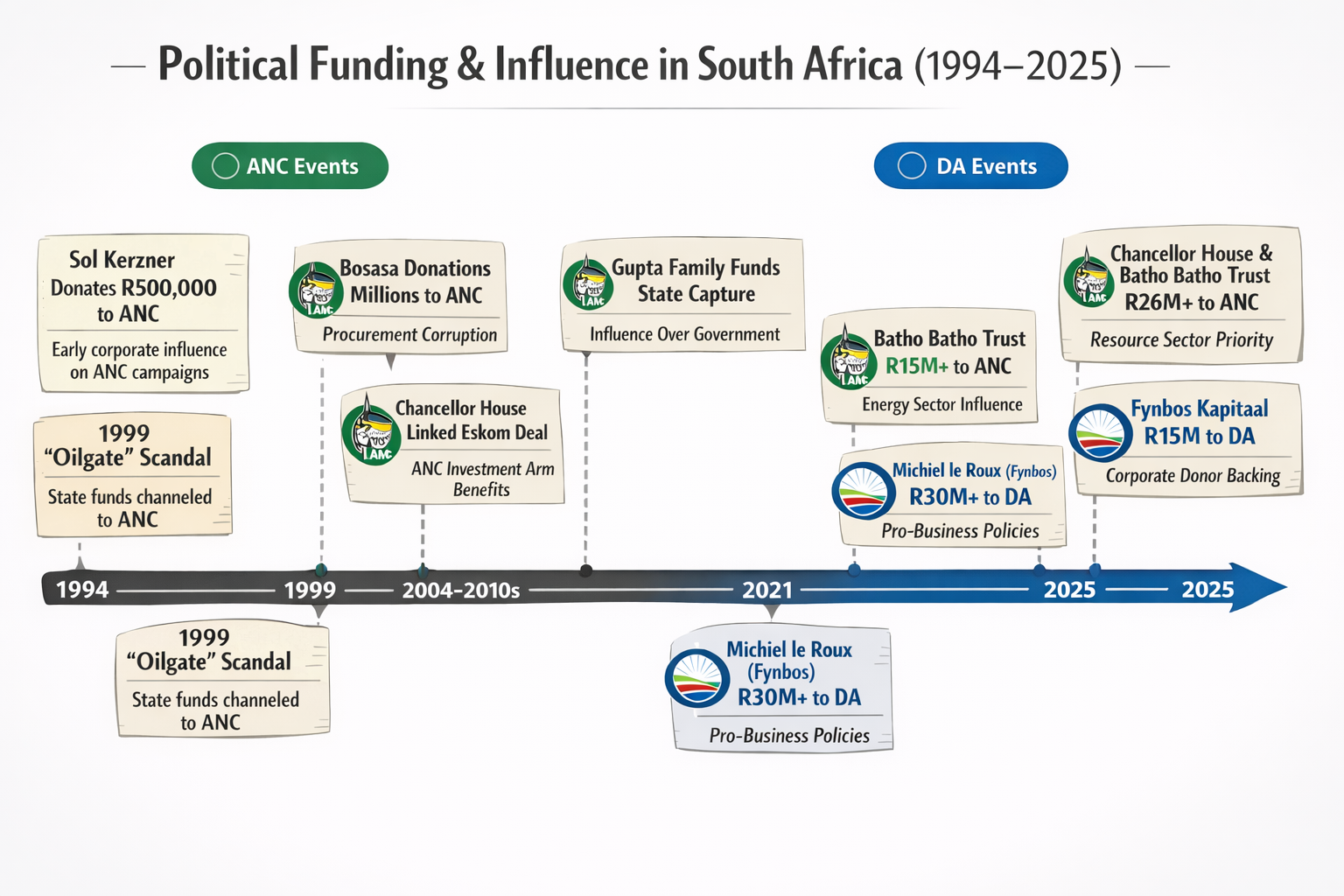
- Chancellor House Trust & Batho Batho Trust (Energy and Resources)
Chancellor House and Batho Batho Trust have been central, long-term funders of the ANC. Batho Batho Trust holds significant interests in Thebe Investment Corporation, which in turn has links to Shell’s downstream operations in South Africa.
- During periods when Shell’s seismic exploration along the Wild Coast faced intense public and environmental opposition, senior ANC figures publicly defended the project. While this does not prove policy was “bought,” it demonstrates a pattern of alignment between donor-linked extractive interests and government positions—often in opposition to public sentiment. Business and Human Rights Centre
- Corporate Donations and Early ANC Campaigns
Business figures such as Sol Kerzner donated to the ANC during the early democratic period, including significant contributions in the 1994 election. This corporate support strengthened the ANC’s electoral machinery during formative years and raised enduring concerns about access, influence, and policy orientation. Sowetan
- Bosasa and Procurement Capture
The Bosasa scandal represents the most explicit example of donor-linked governance distortion. The Zondo Commission confirmed that Bosasa provided cash and in-kind donations to ANC officials in exchange for lucrative government contracts, particularly in correctional services. This constituted a direct subversion of public procurement and democratic accountability. Polity.org.za
- Concentrated Donor Power
Research by organisations such as My Vote Counts shows that a small group of wealthy donors accounts for a disproportionate share of ANC funding, particularly from the energy and mining sectors. While this does not prove vote-buying, it creates structural incentives for policy alignment with resource extraction interests. My Vote Counts+1
The Democratic Alliance (DA) has fewer large-scale corruption scandals, but donor influence remains evident.
Property Developers and Urban Policy (Cape Town)
Under DA governance, the City of Cape Town has frequently approved high-end private developments while delaying or resisting the provision of affordable housing in well-located urban areas. Courts have repeatedly criticised the city for failing to meet constitutional housing obligations, reinforcing spatial inequality.
This pattern reflects alignment with property developers, business elites, and ratepayer interests over those of working-class residents.
Major Corporate Donors
Entities linked to billionaire Michiel le Roux, including Fynbos Kapitaal and Fynbos Ekwiteit, are among the DA’s largest donors. While direct policy causation is difficult to prove, the DA’s emphasis on fiscal discipline, deregulation, and business-friendly reforms aligns closely with the interests of major corporate donors. Newsday
Similarly, donations from corporations such as Naspers and international liberal foundations have helped shape the DA’s policy framing, training, and long-term ideological orientation. Elections South Africa
A particularly noteworthy development in the 2024 election cycle was the Brenthurst Foundation’s first-ever disclosed donation to the Inkatha Freedom Party (IFP). This coincided with the IFP’s entry into national government through the GNU—an unprecedented outcome in the post-1994 era.
This does not imply direct causation. However, it highlights how elite funding networks, policy institutions, and political access intersect in coalition-based systems.
The Brenthurst Foundation, linked to the Oppenheimer business network, is not a neutral donor. It functions as a policy-shaping institution promoting market-oriented reform, governance restructuring, and elite-driven development models.
A similar pattern can be observed in Botswana, where Brenthurst provided intellectual and strategic support to opposition leader Duma Boko before his rise to the presidency. In both South Africa and Botswana, political actors aligned with Brenthurst’s worldview achieved unprecedented access to executive power.
This does not suggest that foundations “choose governments.” Still, it does demonstrate how political success in Southern Africa is increasingly mediated through elite networks that provide funding, legitimacy, policy framing, and international credibility—often beyond direct voter control.
South Africa’s democracy increasingly functions as a system in which voters choose parties rather than governments, coalitions, or policy direction, and in which they lack adequate mechanisms to remove underperforming leadership between elections.
If citizens are to reclaim meaningful power, electoral reform is essential. Voters must be able not only to select their representatives more directly, but also to hold them accountable and remove them when they fail.
Without this, democracy remains procedural rather than substantive—a system of elections without absolute popular control.
That is not freedom.
Freedom is power.
Read Next South Africa Needs a New Electoral System — Not New Parties
About The Author

Lungi Nkosi
Hi, I’m Lungi, the writer and researcher behind Political Nexus. I started this blog because I believe politics and history aren’t just distant, academic subjects — they shape how we live, how we understand the world, and how we imagine the future.
I’m not here to lecture; I’m here to ask questions, share insights, and spark conversations. Whether it’s unpacking a breaking news story, looking back at a key moment in history, or analyzing the choices of today’s leaders, I aim to keep things clear, thoughtful, and engaging.
My interest in politics and history comes from a lifelong curiosity about power — who holds it, how it’s used, and how ordinary people are affected by it. Over the years, I’ve seen how narratives are built, how facts are bent to fit agendas, and how history is used as both a weapon and a guide. That’s why Political Nexus is more than a blog — it’s a space for reflection, inquiry, and conversation.
I write about:
Politics: current events, government decisions, and global trends that affect South Africa and beyond.
History: how past events continue to echo in today’s politics and society.
Media & Narratives: questioning how stories are told, what gets left out, and why.
When I’m not writing, you can usually find me [behind the computer creating stories to tell, exploring books on history and philosophy, debating ideas over coffee with friends, or experimenting with new projects.
At the heart of it, I see myself as a storyteller — one who isn’t afraid to challenge easy answers, ask uncomfortable questions, and look deeper than the surface. My hope is that readers like you walk away from each article not just more informed, but more curious.
So, welcome to Political Nexus. Let’s explore, question, and learn together.
 Rights Without Capacity: Is South Africa Building an Illusion of Delivery?
  Who Funds Court Rulings?
  Media, Rulings & Policy Flow: How Courts Quietly Shape South African Governance
  Framing the Nation: How Media Narratives Shape Political Reality in South Africa
  Governing by Court Order: The Rise of Juristocracy in South Africa
  The Quiet Phasing Out of Childcare Institutions
  If State Power Built Afrikaner Prosperity, Why Isn’t It Working for Black South Africans?