The Failure of Unchecked Majority Rule
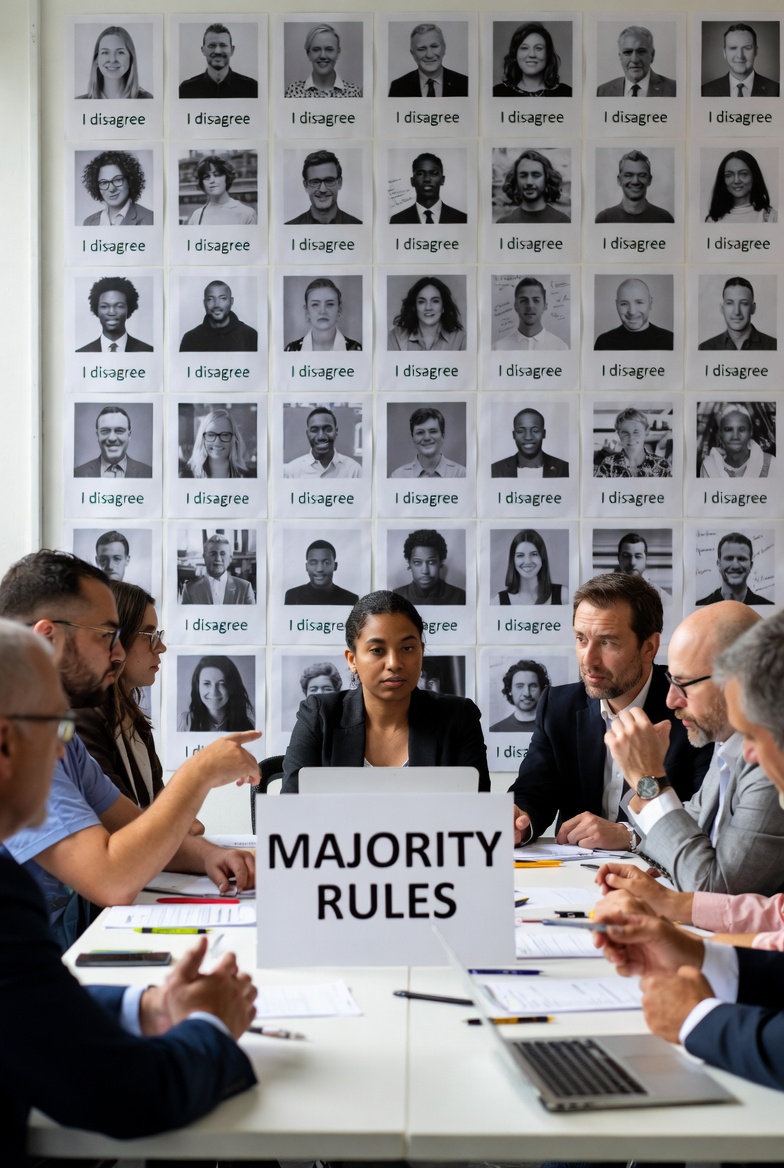
When Majority Rule Does Not Work
Table of Contents
ToggleMajority rule is not the same as democracy
In most democracies, majority rule is treated as the essence of democracy. The idea sounds fair: what most people want should prevail. But this assumption breaks down when the majority is economically vulnerable, historically traumatised, and repeatedly targeted through identity-based political messaging. In such conditions, democratic choice can become susceptible to manipulation rather than a true expression of consent.
South Africa offers a clear case study. For three decades, the same political party has governed the country under a system formally based on majority rule. The persistence of this dominance raises an uncomfortable but necessary question: is majority rule producing accountability, or merely preserving power?
This is not an argument against democracy, nor against Black voters. It is an argument against majority absolutism — the idea that numerical dominance alone confers legitimacy, moral authority, and indefinite governing power.
South Africa’s majority population is Black and shares a profound historical experience with the African National Congress (ANC) as the leading liberation movement. That shared history created what can best be described as a loyalty bind: voting for the ANC was framed not as a policy choice, but as a continuation of the liberation struggle itself.
In the early democratic period, the ANC consistently positioned itself as the sole authentic representative of Black South Africans. Opposition parties were portrayed as:
Representatives of white interests
Remnants of the apartheid order
Threats to Black progress and dignity
Within this framework, political competition was not normalised; it was moralised. Voting ANC became synonymous with defending freedom, while voting otherwise was implicitly framed as betrayal. It was during this period that long-term electoral loyalty was cemented — not through performance, but through identity.
As governance challenges mounted, criticism of ANC performance increasingly shifted from being debated on its merits to being racialised. Critics — including Black intellectuals, trade unions, journalists, and civil society organisations — were branded as:
- “Counter-revolutionary”
- “Agents of white monopoly capital”
- “Enemies of transformation”
Policy critique was no longer addressed substantively. Instead, accountability itself was reframed as racial betrayal. The effect was corrosive: legitimate dissent within the Black majority became politically suspect, narrowing the space for pluralism and internal debate.
Democracy began to function less as a system of accountability and more as a system of loyalty enforcement.
The “white monopoly capital” narrative
During the height of state capture and escalating corruption scandals, the term “white monopoly capital” was aggressively promoted by ANC-aligned figures. While South Africa’s economic inequality is real and deeply racialised, the term was used vaguely and expansively to serve a political purpose.
Rather than functioning as a precise analytical concept, it became a shield against scrutiny:
- Corruption allegations were reframed as racial attacks
- Institutional failure was blamed on external economic forces
- Accountability was cast as hostility to transformation
Public anger that should have been directed at state capture and elite looting was instead redirected toward racial antagonism. This preserved political support without addressing governance collapse.
Election messaging and fear-based voting
In successive elections, opposition parties — particularly the Democratic Alliance — were consistently framed as racist, anti-Black, or agents of minority interests. The message to voters was implicit but powerful: voting for the opposition would mean a return to apartheid-era exclusion or a loss of dignity and rights.
As a result, voting behaviour became defensive rather than policy-driven. Citizens were encouraged to vote against fear rather than for performance. This further entrenched majority dominance while hollowing out democratic choice.
The exposure of the Bell Pottinger scandal confirmed that racial division was not only organic, but deliberately engineered. The UK-based public relations firm was hired to amplify racial tensions and polarising narratives in South African political discourse for the benefit of politically connected clients.
This demonstrated how majoritarian identities can be manipulated rather than genuinely expressed. In the broader state capture context, consulting firms such as Bain & Company also became entangled in the weakening of key institutions, reinforcing narratives of “outsiders versus insiders” and “elites versus the people.” These narratives were politically exploited to deflect responsibility and deepen mistrust.
When the majority silences minorities
The long-term consequence of this political strategy is that minorities — including ideological minorities and Black citizens who do not support the ANC — experience political invisibility. Their rights may exist on paper, but their voices are ignored in practice.
When dissenting groups are delegitimised rather than engaged, democracy becomes symbolic. Elections continue, but representation collapses. Majority rule, instead of facilitating inclusion, becomes a mechanism of exclusion.
Beyond majority absolutism: a disciplined democracy
There is no democracy that functions without some form of majority rule. The problem is not that the majority governs, but that it is allowed to govern without restraint.
A more resilient model is popular sovereignty with supermajority revision. This approach does not abandon majority rule; it disciplines it.
Under this model:
- Ordinary governance remains subject to electoral outcomes
- Day-to-day politics is constrained by the constitution
- Constitutional and structural changes are permitted only through:
- Supermajority thresholds (approximately 65–75%)
- Multiple parliamentary votes
- Meaningful public participation
- Time delays to prevent emotional or populist capture
This ensures that constitutional change reflects deep, sustained consensus rather than temporary anger or identity mobilisation. It forces political actors to persuade beyond their base and makes race-based mobilisation insufficient on its own.
Conclusion: Slowing power down
Majority rule is unavoidable in a democracy. But when it is treated as absolute, it becomes a tool for domination rather than representation. South Africa does not need less democracy — it needs a democracy that constrains power, widens participation, and separates numerical dominance from moral authority.
Democracy fails not when the majority loses power, but when it is allowed to exercise power without limits.
Read Next South Africa Needs a New Electoral System — Not New Parties
About The Author

Lungi Nkosi
Hi, I’m Lungi, the writer and researcher behind Political Nexus. I started this blog because I believe politics and history aren’t just distant, academic subjects — they shape how we live, how we understand the world, and how we imagine the future.
I’m not here to lecture; I’m here to ask questions, share insights, and spark conversations. Whether it’s unpacking a breaking news story, looking back at a key moment in history, or analyzing the choices of today’s leaders, I aim to keep things clear, thoughtful, and engaging.
My interest in politics and history comes from a lifelong curiosity about power — who holds it, how it’s used, and how ordinary people are affected by it. Over the years, I’ve seen how narratives are built, how facts are bent to fit agendas, and how history is used as both a weapon and a guide. That’s why Political Nexus is more than a blog — it’s a space for reflection, inquiry, and conversation.
I write about:
Politics: current events, government decisions, and global trends that affect South Africa and beyond.
History: how past events continue to echo in today’s politics and society.
Media & Narratives: questioning how stories are told, what gets left out, and why.
When I’m not writing, you can usually find me [behind the computer creating stories to tell, exploring books on history and philosophy, debating ideas over coffee with friends, or experimenting with new projects.
At the heart of it, I see myself as a storyteller — one who isn’t afraid to challenge easy answers, ask uncomfortable questions, and look deeper than the surface. My hope is that readers like you walk away from each article not just more informed, but more curious.
So, welcome to Political Nexus. Let’s explore, question, and learn together.
 Rights Without Capacity: Is South Africa Building an Illusion of Delivery?
  Who Funds Court Rulings?
  Media, Rulings & Policy Flow: How Courts Quietly Shape South African Governance
  Framing the Nation: How Media Narratives Shape Political Reality in South Africa
  Governing by Court Order: The Rise of Juristocracy in South Africa
  The Quiet Phasing Out of Childcare Institutions
1 thought on “The Failure of Unchecked Majority Rule”