A Water Revolution — or an Admission of Failure?
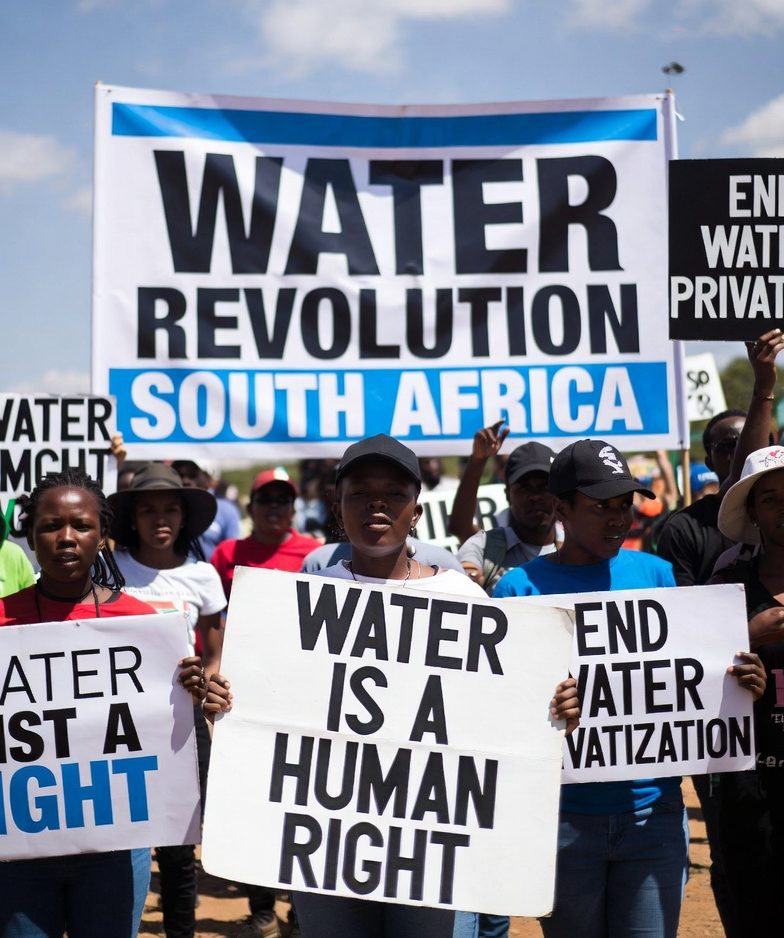
Johannesburg residents have learned a new daily ritual: checking whether water will flow before planning their day. Taps run dry without warning, explanations come later — if at all — and households are expected to adjust.
It is in this context that the Mayor of Johannesburg has spoken of a “water revolution”: a future in which every household stores water in JoJo tanks and relies on rainwater harvesting to meet its needs. But a city without water does not need a revolution. It needs a functioning government..
At first glance, this sounds forward-thinking. Environmental. Practical. But when examined more closely, it raises an uncomfortable question:
Why is a city government planning for households to adapt to water failure instead of fixing the system meant to deliver it?
Table of Contents
ToggleWhen a “vision” quietly lowers expectations
A JoJo tank is not infrastructure. It is an emergency measure.
When a mayor’s long-term vision relies on household water storage, it implicitly accepts that:
- Water interruptions are permanent
- Continuous municipal supply cannot be guaranteed
- Citizens must individually buffer themselves against state failure
This is not resilience. It is a lowering of expectations.
A government’s vision should describe where it is taking society, not how citizens should cope when it cannot perform its most basic duties.
Rainwater harvesting and household storage assume a great deal:
- Formal housing with adequate roof space
- Ownership rather than renting
- Space for tanks and pumps
- Money for installation, maintenance, and filtration
This vision excludes large portions of Johannesburg’s population: informal settlements, backyard dwellers, flat residents, and the urban poor.
A policy that only works for homeowners with disposable income is not a public solution. It is a private coping strategy dressed up as reform.
If water security depends on personal infrastructure, then access to water becomes yet another marker of inequality.
The mayor’s criticism of car washes using potable municipal water is not entirely misplaced. Commercial and industrial users should absolutely be regulated more strictly. Water recycling, alternative sourcing, and differentiated tariffs for high-volume users make sense.
But this is where an important distinction must be made:
Targeting inefficient commercial water use is not the same as shifting the burden of water security onto households.
One is regulation. The other is abdication.
Blurring the two allows the government to appear proactive while avoiding the harder task of repairing, maintaining, and expanding core infrastructure.
Planning for survival instead of governance
Perhaps the most concerning aspect of this “water revolution” is what it signals about the state’s mindset.
When citizens adapt successfully — storing water, harvesting rain, coping quietly — pressure on government decreases. Outages become less urgent. Accountability weakens. Failure is normalised.
Emergency measures become permanent policy.
And slowly, a constitutional right is reframed as a personal responsibility.
A real water vision would look different
A genuine water revolution would focus on:
- Fixing leaks and ageing pipes
- Reducing non-revenue water losses
- Expanding and maintaining bulk infrastructure
- Professionalising municipal water management
- Holding contractors and officials accountable
Household rainwater harvesting could play a supportive role—encouraged, incentivised, and integrated—but never be positioned as a substitute for municipal obligations.
Conclusion
A city does not need a revolution that teaches its residents how to survive without it.
It needs leadership that insists water supply is not optional, not seasonal, and not negotiable.
A government that plans for households to store water is not planning to govern.
It is planned to be endured.
About The Author

Lungi Nkosi
Hi, I’m Lungi, the writer and researcher behind Political Nexus. I started this blog because I believe politics and history aren’t just distant, academic subjects — they shape how we live, how we understand the world, and how we imagine the future.
I’m not here to lecture; I’m here to ask questions, share insights, and spark conversations. Whether it’s unpacking a breaking news story, looking back at a key moment in history, or analyzing the choices of today’s leaders, I aim to keep things clear, thoughtful, and engaging.
My interest in politics and history comes from a lifelong curiosity about power — who holds it, how it’s used, and how ordinary people are affected by it. Over the years, I’ve seen how narratives are built, how facts are bent to fit agendas, and how history is used as both a weapon and a guide. That’s why Political Nexus is more than a blog — it’s a space for reflection, inquiry, and conversation.
I write about:
Politics: current events, government decisions, and global trends that affect South Africa and beyond.
History: how past events continue to echo in today’s politics and society.
Media & Narratives: questioning how stories are told, what gets left out, and why.
When I’m not writing, you can usually find me [behind the computer creating stories to tell, exploring books on history and philosophy, debating ideas over coffee with friends, or experimenting with new projects.
At the heart of it, I see myself as a storyteller — one who isn’t afraid to challenge easy answers, ask uncomfortable questions, and look deeper than the surface. My hope is that readers like you walk away from each article not just more informed, but more curious.
So, welcome to Political Nexus. Let’s explore, question, and learn together.
 Rights Without Capacity: Is South Africa Building an Illusion of Delivery?
  Who Funds Court Rulings?
  Media, Rulings & Policy Flow: How Courts Quietly Shape South African Governance
  Framing the Nation: How Media Narratives Shape Political Reality in South Africa
  Governing by Court Order: The Rise of Juristocracy in South Africa
  The Quiet Phasing Out of Childcare Institutions
1 thought on “A Water Revolution — or an Admission of Failure?”